Labradorite is a distinctive feldspar mineral primarily known for its play of color (labradorescence), practical applications featuring dark bases with flashes of blue, green, or violet, and suitability for daily wear due to its moderate hardness. Its value reflects origin, color intensity, and surface finish.
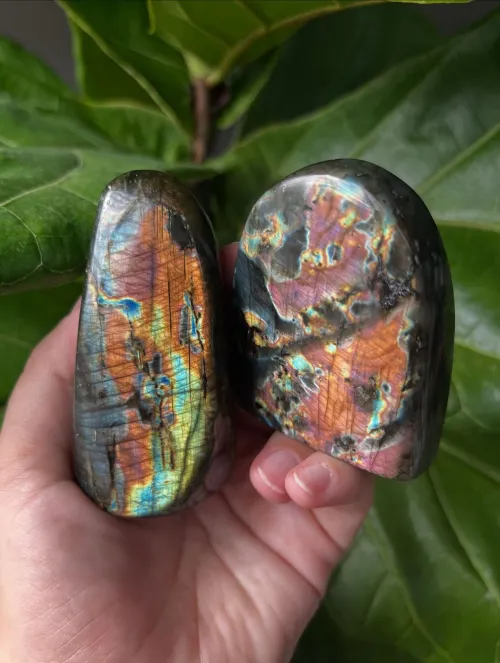
Imagine browsing a jewelry store counter, your eye catching a brooch that flickers with electric blue as you tilt it. Or maybe you're unpacking an online order: a smooth palm stone that shifts between muted greens and silvers under your kitchen lights. When people ask "What exactly does labradorite do?", they're often reacting to moments like these—puzzling over why one semi-precious piece catches every gaze while another sits dull. This guide cuts through the overwhelm with a straightforward checklist: eight key aspects to decode its reputation, whether you're handling raw slabs, picking jewelry, or just matching that Instagram post to reality.
Beyond just "shiny rocks," this section unpacks why labradorite draws prolonged fascination. Knowing these mechanics helps avoid overpaying for weak effects or missing subtle beauty in raw pieces.
The magic lies in labradorescence. When light hits internal micro-layers within the mineral, interference occurs—splitting rays like a prism. You might notice rainbow flashes on polished pendants during morning commutes, or hidden teal sparks in uncut specimens under a store spotlight. This isn't surface glitter; it's structural performance tied to crystal formation.
Common base colors include charcoal grey or near-black with flashes in blue-green spectrum. Premium pieces show wider chromatic range—violet, gold, or copper flashes—owing to unique internal alignments during formation. While eye-catching, strong hues don't imply mystical properties; they signal geological conditions.
Forget vague attributes; labradorite’s real-world viability hinges on technical specifications. Whether considering a ring or carvings, evaluate these before purchase.
As plagioclase feldspar, it scores 6 on Mohs scale—comparable to steel nails. This means everyday exposure like typing rings won’t shatter it, though sharp knocks risk dents. Think practicality: a labradorite bracelet survives groceries and phone scrolling, but isn't ideal for heavy machinery work.
Formed in igneous rocks, extraction occurs globally with notable origins in Canada and Madagascar. A friend once hesitated over two equally vibrant pendants—one labeled "Canadian," carrying slight price premiums linked to sourcing transparency. Not all sellers disclose provenance consistently.
How does labradorite translate from mineral shows to practical life? From pocket stones to pendant lights, application drives appeal.
The stone cuts reliably into beads or cabochons, with weight/size impacting feel. Mala beads use smaller pieces for comfort during movement, while statement rings require secure settings like partial bezels. Matte finishes work for minimalist aesthetics; highly polished facets amplify brilliance under cafe lights.
Architectural applications leverage larger slabs—picture backsplashes shimmering under kitchen downlights to create moving textures. Smaller clusters become paperweights or desk objects offering visual breaks while scrolling emails.
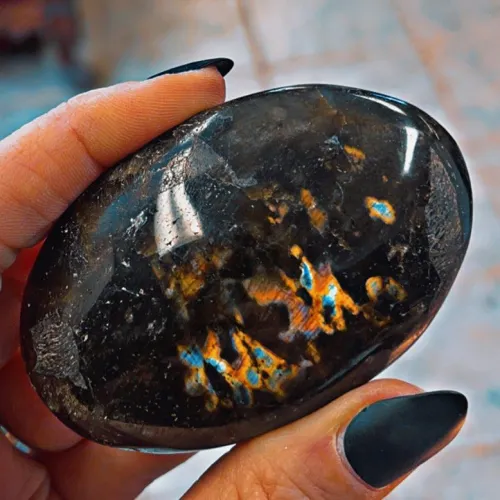
Three purchase scenarios reveal authentication needs: comparing sellers online, spotting fakes at a flea market, or inheriting old jewelry.
Lab-grown glass mimics flashes but lacks depth. Glass shows uniform bubbles and brighter artificial colours. Authentic pieces have consistent diffusion across fracture lines and irregular colour zoning.
Pricing fluctuates based on thickness (affecting flash visibility) and surface quality. Retailers emphasizing ethical extraction or offering geological verification add trust layers beyond vague "premium" claims.
Understanding formation makes you a savvier observer, especially when sellers embellish claims.
The crystal structure develops through cooling molten rock, forming stacked layers at microscopic scales. These interfere with light wavelengths—blue travels through thinner gaps while thicker layers bounce back golds. Your friend admiring necklace flashes is essentially seeing fossilised liquid dynamics.
Historical links include Inuit legends and New Age narratives. Detach these from verifiable traits: no double-blind study proving mood alteration exists—but users report tactile sensation during mindfulness. That smooth weight becomes a tactile anchor.
Condensing key aspects: When encountering labradorite—whether in photos, shops or heirlooms—run through this mental triage:
Picture unboxing another gem purchase soon: How might these checks change your inspection routine? Perhaps testing labradorescence angles first, then verifying hardness against quartz? Carry this framework—you decide what merits value now.
Q: Does it degrade with regular wear?
A: Lab-grade chemicals or ultrasound cleaning may damage surfaces, but routine exposure to humidity and mild temperatures doesn’t degrade structural integrity.
Q: Why recommend specific origins?
A: Material from Finland or Canada often displays distinct optical qualities tied to geological conditions. It isn't inherently "better," but meets certain visual preferences consistently.
Q: Is color intensity linked to thickness?
A: Thinner cuts (below 3mm) tend to exhibit reduced flashes compared to slabs. Stone orientation also controls observed patterns.


$
