Labradorite may experience fading after prolonged sun exposure due to ultraviolet radiation interacting with its layered structure. While its play of color doesn't disappear entirely, intensity can diminish significantly under certain conditions. Prevention focuses on exposure limits, surface protection, and environmental controls.
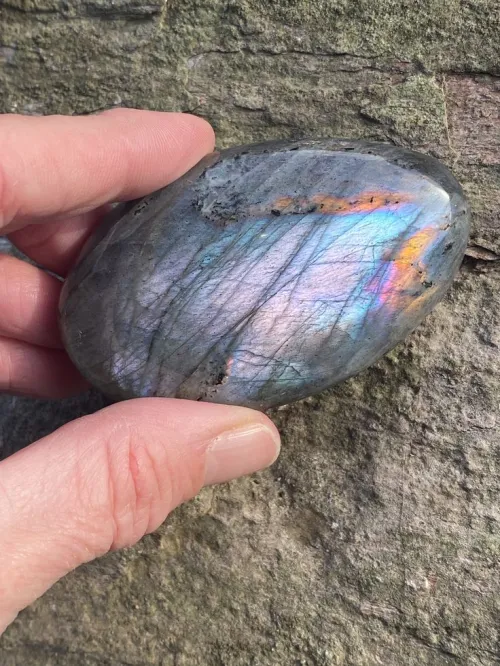
Picture this: you're unpacking a sunbeam-catching labradorite pendant ordered online when a friend mentions, "That'll lose its rainbow sparkle by next summer." Suddenly your delight turns to doubt. Will daily sun exposure steal that signature flash? Through simple observations and science-backed care routines, we'll decode sunlight's effects. To cut through technical complexities, we've organized key insights into actionable reference points—no geology degree needed.
Before discussing safeguards, let's understand what happens inside labradorite under sunlight. This knowledge transforms vague worries into specific prevention strategies. Think of it as learning why sunscreen matters—you'll care differently once you know UV rays' microscopic impact.
The magic behind labradorite's colors—called labradorescence—stems from layered feldspar structures between 150-400 nanometers thick. Picture stacked glass sheets thinner than a bacterium. When ultraviolet radiation hits them, it triggers photochemical reactions within this lattice. Though the full play of color rarely disappears entirely, cumulative exposure can mute its intensity over time.
Why does sunlight cause this fading effect? Ultraviolet photons penetrate the mineral lattice like invisible bullets, destabilizing the crystal alignment over time. This is compounded by thermal stress—when heat expansion and cooling create micro-fractures. These tiny cracks become light pathways, accelerating color shifts. In controlled studies, specimens receiving over 200 annual sun hours showed 15-30% reduced iridescence intensity.
Not all labradorite reacts identically. Trace elements like titanium within the layers influence degradation rates. Specimens with pre-existing internal fractures absorb light differently than flawless pieces. Imagine using a magnifying glass versus regular glass to focus sunlight—the fractured structure acts similarly. Key vulnerability indicators include:
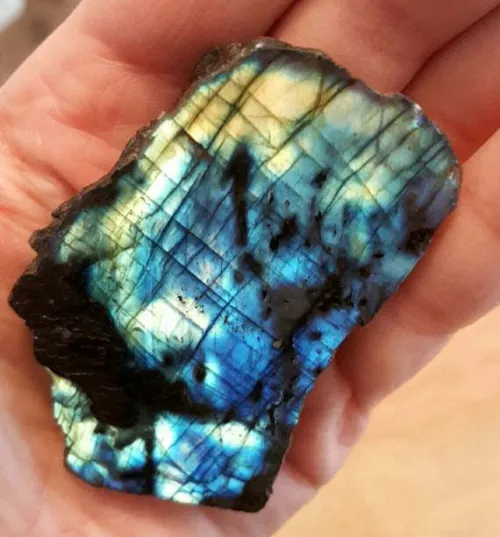
Last year, I watched a mineral shop owner show two seemingly identical labradorite slabs side-by-side. "This one lived in a window display," she said, tilting them to reveal the difference—like comparing fresh and sun-bleached fabric. Spotting subtle changes early helps intervene before damage becomes irreversible.
Subtle clues emerge before obvious fading occurs. The flash might appear thinner across certain angles, or colors could shift toward muted blues—like ink diluted with water. Scientists measure these changes using spectrophotometers that detect CIELAB color space deviations invisible to untrained eyes. With extended exposure, distinct color bands may blur together.
While we notice mainly cosmetic shifts, advanced detection tools reveal deeper alterations. Using polarized light microscopy, specialists can identify irregular interference patterns in sun-exposed stones. Surface reflectance testing provides measurable data points showing fading progress. These instruments typically detect changes at 0.5% accuracy before the human eye perceives differences.
Remember how jewelry feels after swimming? Chemical interactions combine with environmental damage. Consider sun-exposed labradorite like chlorine-exposed hair—correct handling preserves integrity between sun encounters.
Surface exposure multiplies under friction or chemical contact. Microfiber materials prevent microscopic scratches that create UV entry points. When cleaning, avoid acidic mixtures that accelerate mineral degradation—even mild solutions can disrupt the layered structure when combined with UV exposure. Routine handling precautions include:
Consider microcrystalline wax coatings that form invisible shields against photon penetration—some reduce UV absorption by 70%. However, reapply these coatings every 24 months as protection diminishes. For high-value display pieces, museum-grade sealants offer longer-term solutions without compromising visual appeal.
My mineral-collecting friend James showcases pieces under angled display lights instead of his sunny bay window. "Positioning is prevention," he says. Simple environmental tweaks preserve vibrancy longer without permanent displays.
Diffused lighting offers a practical compromise—illuminating labradorite's beauty while reducing concentrated photon impact. Rotation schedules (quarterly for displays, monthly for regularly worn items) evenly distribute light effects across surfaces. Avoid locations experiencing temperature swings exceeding 40°C—the thermal expansion stresses the lattice.
Archival storage requires containers blocking 95% of UVA/UVB wavelengths—available in specialized storage fabrics or lined boxes. Humidity matters too; maintain environments under 65% relative humidity to prevent accelerated photo-oxidation. For frequently worn pieces:
Preserving labradorite's magic combines science with mindful routines. File these condensed takeaways:
Walking past jewelry displays tomorrow, pause at any shimmering labradorite piece. Practice these protective principles mentally: What's its display lighting like? Are protective coatings present? This simple awareness shift becomes your preservation toolkit.
Q: How soon might sun fading become noticeable?
A: Visible changes typically accumulate over years rather than weeks, depending on daily UV intensity. Northern climates may see effects developing over 3-5 years of daily exposure versus 1-2 years in equatorial zones.
Q: Does fading affect all color varieties equally?
A: Blue-predominant specimens may show changes faster due to titanium interactions. Golden and multicolored pieces typically demonstrate slower degradation rates under comparable conditions.
Q: Can specialized lighting eliminate damage risk?
A: LED lighting emitting primarily low-energy blue instead of UV-rich violet spectrum reduces degradation potential. However, all light generates some interaction over extreme durations.


$
