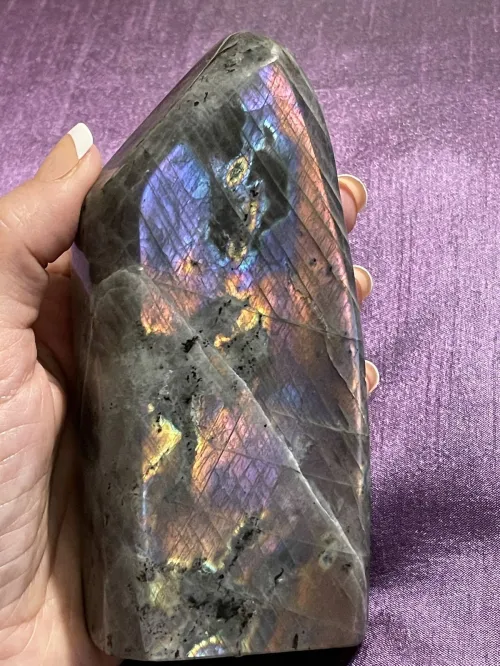
Picture a rainy Sunday afternoon in a cozy crystal shop—you're holding a gray stone that suddenly unleashes a miniature aurora across its surface as you rotate it. You turn it in half-light near the window, and electric blue streaks emerge. Later that night at home with the lamp off, you check again... nothing but a dark silhouette. That abrupt disappearance in the dark leads to this question: what's really happening? With so many claims about "glowing stones," we've organized this visual guide into six fundamental principles. Instead of wading through complex jargon, these bullet-point observations will help your eyes notice what science actually shows.
Understanding labradorite's visual charm involves recognizing how light navigates hidden landscapes inside the mineral. Many buyers assume vibrant stones produce their own glow, leading to unrealistic expectations about dark-room displays. These core principles reset your perspective to what’s physically achievable.
Unlike glow-in-the-dark minerals, labradorite relies on exterior lighting due to intricate lamellar structures within. Picture thousands of transparent crystalline shelves stacked internally—around 0.01mm thick. When light enters, it fractures into spectral colors at countless microscopic junctions. The Schiller effect occurs as these layered boundaries—each with varying refractive indices—split incoming beams like a natural prism array.
This section unpacks why labradorite behaves like trapped starlight rather than a glow-stick. Misunderstanding this critical difference could leave people checking dark corners for shimmer that'll never appear—these details equip you to assess realistic visual potential.
Color production correlates directly with structural thickness: lightwaves diffracting through microscale layers create interference patterns. The most common blues and golds occur because these wavelengths correspond to narrow (~0.1 micron) gaps mineralogists call lamellae. Interestingly, cutters tilt crystals against these layers for maximum visibility—a 30º offset may intensify hues 300% compared to flat-facing slices.
When assessing legitimacy, consider refractive index values (typically 1.55–1.57). Counterfeits like dyed howlite fail because they lack the multi-phase mineral composition necessary for authentic light splitting. Genuine specimens appear milky-gray when backlit—the play of color lives exclusively on the surface plane.
Ever wonder why labradorite dazzles under museum lights but turns mute on your bookshelf? Mastering illumination angles transforms ordinary stones into light-catching performers. These adjustments prevent "disappointment scenarios" where buyers never see advertised colors.
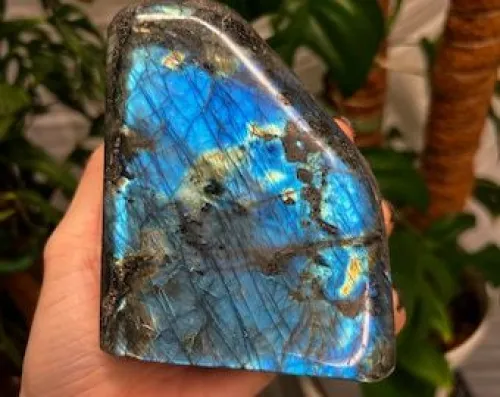
Peak iridescence requires directional light positioned opposite your eye. When examining raw pieces or jewelry, tilt the specimen slowly under a lamp or window. Notice how color flashes vanish beyond 40° and strengthen within 10-35°—a principle jewelers exploit during stone orientation. This angular sensitivity means overhead ceiling lights often produce underwhelming results: ideal illumination hits the specimen obliquely.
Between counterfeits and natural variations, labradorite's appearance confuses newcomers. Recognizing subtle visual signatures helps identify genuine specimens whether you're at a flea market or comparing online photos.
Surface cracks exceeding 0.2mm depth refract photons away from layered structures. While the stone remains intact, light diffusion efficiency may drop visibly—picture a headlight dimmed by mud. Similarly, specimens with extensive internal fracturing scatter light randomly, yielding duller displays. Hold potential pieces against printed text: good translucency allows blurred text visibility through 3-8mm slabs.
Compared to cubic zirconia’s intense sparkle, labradorite acts like nature’s dimmer switch—its reflections feel deep rather than brilliant. Testing against known references sharpens your perception: moonstone shows milky-blue adularescence (softer scattering), while rainbow obsidian lacks underlying crystalline layers.
That pendent chipped last Tuesday? Knowing material limitations prevents heartbreak. Labradorite ranks 6-6.5 on the Mohs hardness scale—harder than window glass but vulnerable to hard knocks. These protocols ensure your piece remains pristine.
Thermal instability creates microfissures if exposed to fast temperature shifts exceeding 20°C. Your stovetop or freezing car dashboard could cause irreversible light-path alterations within minutes. Similarly, household acids (vinegar, citrus cleaners) gradually erode polish despite labradorite's moderate chemical resistance—a sealed bezel offers added security.
"But Instagram showed violet-glowing labradorite!" Social media dazzle often obscures physics. This final check dismantles widespread illusions to anchor expectations in measurable phenomena.
Measure ambient light with any lux meter app: below 0.1 lux (moonless night conditions), all labradorescence ceases regardless of claims about "charged minerals." No verified documentation shows labradorite producing phosphorescent emissions after light removal—so if something glows green in pitch darkness, it's likely treated fluorite.
Decades of direct sunlight may cause yellowing due to microscopic iron oxidation, while temporary UV exposure (like blacklights) creates negligible shifts. This slow degradation differs radically from immediate photochromic effects seen in some gems. To preserve original clarity, occasional underwater immersion poses minimal risk if followed by thorough drying.
Those quick takeaways in your pocket mean little without context—here's applying them. When visiting galleries, pause at displayed specimens: tilt them deliberately. Watch how electric blues emerge only when ceiling lights strike at 30° rather than 60°. Notice auction sites mention "eye-clean" stones without fractures? That preserves diffraction efficiency. Remember: if a seller claims "glow," verify their definition—true labradorescence depends entirely on available illumination. With these observation tactics, what will you notice differently tomorrow?
Q: Can labradorite show colors under candlelight?
A: Yes, though faintly. Low-lux environments like candlelight (1-10 lux) may reveal subtle flashes at optimal angles. Intensity drops significantly compared to daylight or bulbs.
Q: Do all labradorite types produce blue flashes?
A: Dominant colors depend on layer thickness and mineral impurities. While blues and golds are common, violet or green flashes may appear in specific specimens—though intense reds remain unlikely.
Q: Will labradorite gradually lose its color-play over time?
A: Surface scratches or deep fractures can diminish visible effects, while thermal shock may create microfissures altering light paths. However, undamaged specimens usually maintain iridescence indefinitely under proper care.


$
