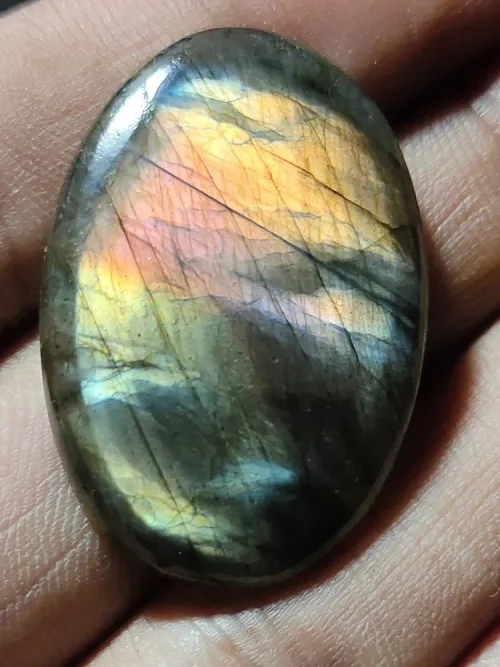
Picture a sunny afternoon where you unpack labradorite earrings from your mailbox, immediately noticing their play of blues and greens. As you place them near your sunlit window, the lingering question strikes: "Is this safe?" Such everyday moments spark uncertainty about mineral care. This guide cuts through confusion with science-driven insights organized for quick referencing. Instead of overwhelming details, you'll find clear protocols to maintain your stone's integrity.
This section unpacks labradorite’s physical relationship with light. Recognizing why certain restrictions exist helps develop instinctive handling habits, ensuring your specimens maintain signature optical effects without risky experimentation.
Labradorescence – that captivating color play – may diminish under extended UV exposure. The phenomenon occurs when layers within its crystalline structure reflect light differently, but ultraviolet radiation can degrade these light-bending properties over time, particularly in stones with higher iron content. Surface temperatures above 85°F may additionally accelerate wear patterns, though impacts vary across specimens.
As a sodium calcium aluminum silicate mineral scoring 6-6.5 on Mohs hardness scale, labradorite absorbs and processes light uniquely. Its crystalline formation includes microscopic fractures that scatter light to produce iridescence, yet those same structural features increase vulnerability to thermal stress when moving rapidly between extreme temperature environments. Thicker specimens generally resist sun impacts better than delicate slices due to slower heat permeation.
Applying safety limits prevents cumulative sun damage while preserving aesthetic qualities. These boundaries account for duration, environmental factors, and specimen characteristics that collectively determine risk levels during actual use.
Keep outdoor sessions under two hours with intermittent monitoring. Early morning or late afternoon indirect sunlight tends to pose minimal fading risks when humidity remains below 60% and temperatures stay under 85°F. Avoid placing stones directly on reflective surfaces like mirrors that concentrate light beams onto specific zones. Rotate display pieces weekly if near sunlit areas to prevent uneven color distribution.
When moving specimens between environments, allow gradual temperature transitions preventing thermal shock – a material stress response occurring with shifts exceeding 10°F per hour. Utilize microfiber cloths rather than water-based cleaning during summer months since existing micro-fractures can expand when moisture trapped in crevices heats rapidly. Store pieces in padded containers during transport to minimize vibrational impacts compromising structural integrity.
Spotting subtle changes early helps prevent irreversible damage. These symptoms operate as diagnostic benchmarks signaling when protective measures need strengthening.
Notice fading starting at edges where light exposure concentrates? This reduced color play suggests UV degradation. Other warning markers include temperature-induced fissures appearing as spiderweb lines underneath surface fractures, or white powdery residues indicating mineral dehydration. Regularly inspect stones using magnifying tools under consistent indoor lighting to establish condition baselines.
Understanding alternatives provides complete care freedom regardless of environment. These methods maintain visual and structural integrity without compromising protection objectives.
Moonlight cleansing overnight during lunar phases represents a zero-risk option comparable to brief sunlight exposure. Dry brushing with soft brushes effectively removes debris without liquids threatening structural coherence. For larger display pieces, museum-style protection can involve UV-filtered glass cases maintaining 40-50% humidity control without compromising viewing angles.
Picture wearing your labradorite pendant indoors where ambient temperature fluctuations stay minimal, removing it before gardening or beach days. When gifting stones, include moisture-absorbing silica packets in storage containers for recipients living in humid climates. Rotate displayed specimens using a simple "in sun/resting" schedule: one week near filtered light, three weeks resting in shadowed areas.
Many worry about losing stones' "energy" while protecting them, but preservation methods don't diminish properties – they maintain crystal structure integrity against entropy. Another concern claims sunlight strengthens stones, though measurable evidence shows improved durability comes only from careful usage patterns. Regular brief handling sessions preserve surface-bonding effects better than uncontrolled environmental exposure.
Consistent attention to four concepts preserves labradorite’s visual and structural potential: Monitor light exposure timing regularly; implement rotation schedules preventing uneven aging; prioritize gradual temperature transitions always; establish moonlit cleansing as your default method.
Before leaving labradorite near that sunlit windowsill tomorrow morning, consider: How will rotation timing preserve its signature blues? Might that gift require humidity-control packets? Such ordinary moments become opportunities to apply material science practically. What tiny adjustment today maintains tomorrow’s brilliance?


$
