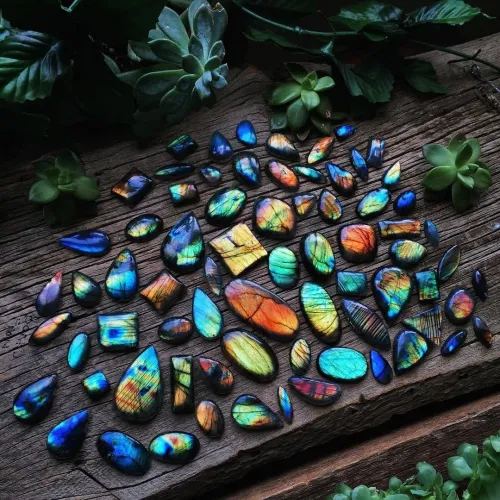
Picture yourself sifting through an online marketplace or a local craft fair, spotting intriguing blue-green stones catching the light. A friend leans over, pointing at a $29.95 pendant: "How do you know it's worth it?" Without relying on mystical claims or brand hype, identifying substantial labradorite becomes about anchoring expectations to visible, tactile indicators. This practical checklist equips you with grounded observations to separate standout finds from ordinary ones—focusing on what light reveals, how weight settles in hand, and why certain finishes endure daily life. Whether browsing or unboxing, you'll navigate choices using specific checkpoints based on minerology rather than instinct.
Before scrutinizing price tags, grounding your expectations in mineral realities prevents disappointment. Labradorite isn't defined by price but by labradorescence—light breaking across mineral layers creates flashes often absent in synthetics. Knowing this shifts attention from cost to visible phenomena.
Labradorite's signature effect stems from subsurface interference.
Imagine light hitting stacked mineral layers at different angles, fracturing into blue-green-gold bursts—a structural fluke rather than surface treatment. Pieces under $50 display authentic flashes when these internal patterns align correctly. Composition isn't uniform; some areas stay dark gray while vivid sections shine, making consistent 50% visible flash a benchmark for quality without mysticism.
Weight and texture offer tangible validation.
Picture testing a $19.95 tumbled stone: its cool heft balanced against palm size warns if stability could falter in larger formats. Surface finishing minimizes sharpness while preserving integrity—a smooth polish shouldn't hide significant fissures. Well-executed pieces exhibit consistent edges across irregular natural forms.
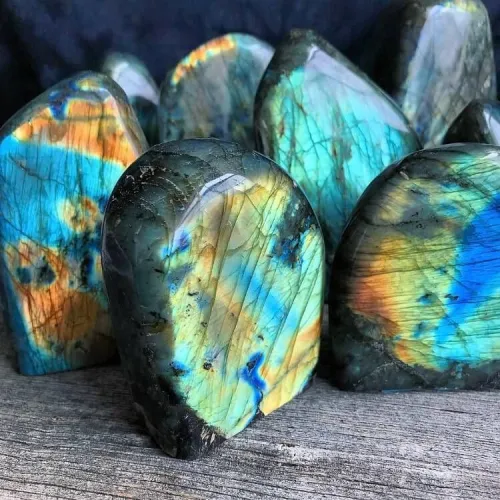
Labradorite's true character emerges under controlled lighting—unlike flat imitations. Focusing exclusively on flash extent versus color myths filters hype, helping you recognize pieces where labradorescence transforms dull stones through interplay of structure and photons.
The iridescence threshold defines market tiers.
Think of a $35 pendant: tilting it beside a window, does flash cover 50% surface? Can it project blue/gold streaks onto skin? Dynamic visual effects indicate precise layer alignment capable of interacting with environments. While not all affordable pieces achieve 70% coverage (common beyond budget), consistent vibrancy across light angles signals good structuring.
Gold flashes often accompany cheaper variants, blue/green indicates higher mineral grades—but both coexist at $50.
A friend once dismissed a $45 brooch as "too gray" until sunlight revealed emerald arcs. Base hues often seem unremarkable without angled lighting; color zoning—where bands of flash vary—is natural versus imperfection. Affordable options might show uneven distribution, but isolated intense zones still ensure visual payoff during wear.
Touching a piece bridges abstract value and daily utility. Weight distribution impacts wearability, surface textures reveal craftsmanship priorities, and edge integrity hints at longevity—elements assessable through tangible interactions.
Finishes alter appearance and functional reliability.
Recall holding a rough specimen versus a $39.99 ring base: polished versions enhance flashes but expose cracks; matte finishes mask flaws but reduce light dynamics. Effective edge finishing minimizes vulnerability areas prone to chipping. Verify no deep fissures exist along boundaries during manual inspection.
Weight and dimensions inform comfort during usage.
Unpacking a stud earring set? Notice if backs sit securely without lobe strain. Decorative chunks meant for shelves? Compact designs under 80 grams maintain stability. Pieces engineered for portability include smoothed geometries that resist snagging during transport.
Labradorite finds purpose through deliberate shape adaptation—pendant backs shaped for easy chain threading, decorative bases flattened for stability. Aligning physical properties to your scenarios prevents buying pieces too fragile or cumbersome for actual deployment.
Jewelry requires weight restrictions; decor accepts chunkier forms.
Imagine a $22.50 paperweight: its mass stabilizes papers adequately despite lacking high-end flash density. Similarly, pendants below 25 grams distribute evenly on chains. Purpose-driven sizing ensures labradorite doesn't become drawer clutter through impractical dimensions.
Geometric versus organic cuts serve different aesthetics.
Picture gifting a faceted rectangular cabochon as cufflinks versus irregular palm stones as worry pieces. Functional adaptability comes through considered cuts: angled displays catch light dynamically, while rounded tumbled stones fit pockets comfortably. Choosing depends on where your labradorite will live—draped, displayed, or carried.
Preserving labradorite's allure requires routine adherence to inherent limitations—its resistance to damage stays moderate even at best. However, understanding susceptibility to moisture/impacts guides realistic care extending desirability well past purchase.
Surface preservation relies on simple steps.
After wearing that budget pendant all day, gentle water rinsing lifts oils threatening surface gloss. Chemicals weaken structural integrity, so avoiding cleaning agents prevents dulling. Color retention benefits substantially from darkness—storing pieces in fabric pouches suffices to prevent UV degradation.
Falls onto hard surfaces usually incur damage despite ~6 Mohs hardness.
A friend once broke a labradorite coaster against tile; resilience proves adequate against keys or incidental bumps but brittle against major trauma. Treating pieces as heirlooms under $50 creates disappointment. Instead, appreciate them for visual enrichment with managed physical exposure.
Whenever you next encounter "affordable labradorite," mentally replay these filters: First, does light interaction create shifting flashes across a significant surface area? Second, are edges seamlessly finished without fissures disrupting integrity? Third, does weight/design align with intended usage? Holding these three anchors prevents reactive purchasing—you’ll pause at checkout, reassessing pieces through practical optics rather than hype.
Q: Why some $30 pieces seem smaller than expected?
A: Size involves mineral density tradeoffs—some flash-intensive layers concentrate in smaller volumes. Assess relative flash area coverage over mere dimensions.
Q: Can lower-priced options feature "spectrolite" flashes?
A: Authentic spectrolite remains rare outside limited locales. Vivid blue-green flashes are possible but typically cover less surface than premium grades, yet still provide significant visual play.
Q: Do display pieces require specialized lighting?
A: Strategic placement near ambient daylight or accent lamps enhances iridescence; direct intense exposure risks fading over extended periods for all grades regardless of pricing.


$
